The Common Mechanism is a free, open-source, globally-available tool for synthesis screening. Our automated software for screening sequences of nucleic acids, including DNA and RNA, was shown to sensitively flag sequences of concern without raising unnecessary alarms.
This note describes the results of testing done before the release of version 0.1 of the sequence screening package. Before the launch of the software in May 2024, our testing showed:
Summary of findings
- Compliance with industry best practices when tested against real customer order streams by beta testers such as Twist Bioscience.
- Fewer than 2% false positive flags across a registry of real synthetic biology designs.
- Performance on par with industry screening tools on a standard test set.
- Resilience to AI-generated challenges.
Detailed performance
Below is a summary of test results from beta testing by synthesis providers and from internal testing of the software prior to the v0.1 release.
Compliance with best industry practices
Twist Bioscience ran a series of real customer orders through the Common Mechanism, finding that the tool would allow users to screen their orders in compliance with industry best practices. A number of other synthesis providers (benchtop manufacturers, academic biofoundries, and smaller synthesis companies) were engaged to install and test the tool during beta.
The Common Mechanism is designed to meet and exceed current screening guidance, such as the IGSC Harmonized Screening Protocol and the U.S. Framework for Nucleic Acid Synthesis Screening. IBBIS is a member of the International Gene Synthesis Consortium and an active participant in efforts to standardise best practices for synthesis screening, including ongoing engagements with EBRC and NIST.
Fewer than 2% false positive flags
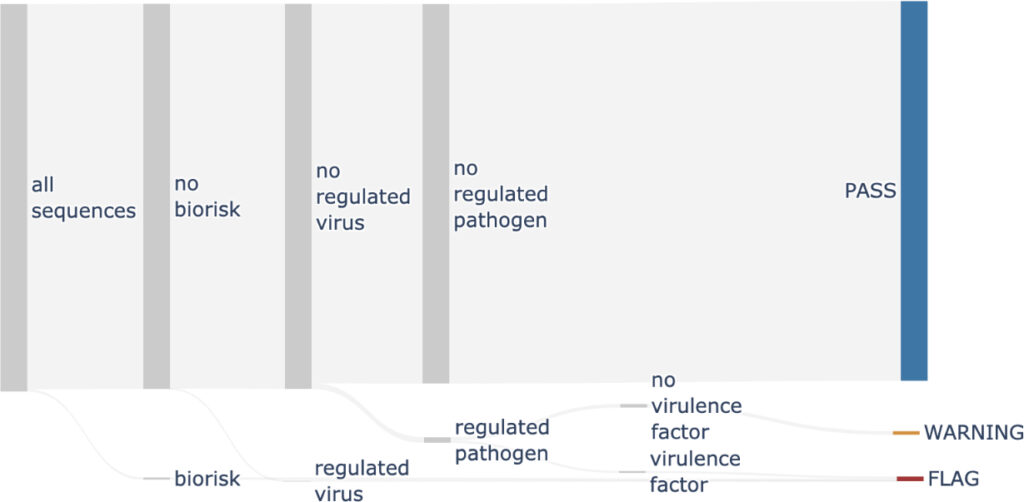
The Common Mechanism was run against the iGEM Registry of Standard Biological Parts, a public database capturing over 20,000 biological parts used to build synthetic biology devices and systems. Teams in the international iGEM Competition submit the parts designed for their projects to the Registry each year.
In total, less than 2% of the parts were flagged (422 of 22,809). Not all of these represent false positives; the search in fact highlighted several sequences that we have reported to iGEM HQ as likely requiring safety flags.
Performance on par with industry screening tools
IBBIS is among the screening tool providers participating in the development of a standard test set for benchmarking synthesis screening performance.
As reported in Progress and Prospects for a Nucleic Acid Screening Test Set, the Common Mechanism showed strong alignment with other screening tools: 100% agreement for Orbivirus sequences, 99.5% agreement for bacterial sequences from Coccidioides, and 92.1% agreement for fungal sequences from Francisella tularensis. Other tools showed similar levels of agreement and disagreement.
The Common Mechanism is being tested against sequences from every pathogen on the U.S. Select Agent List and the Australia Group Common Control Group List, paired with sequences from non-listed close relatives. Results will be reported once consensus flags have been established among the working group of RTX BBN, Aclid, and Battelle.
Resilience to AI-generated challenges
The Common Mechanism has been tested against a range of obfuscation challenges: functional reformulation using AI protein design tools, camouflaging sequences with “decoy” non-hazard sequences that could be removed using standard laboratory methods, and splitting hazards for later reassembly.
A preprint addressing resilience to synthetic homologs created with protein design tools is available on bioRxiv: Toward AI-Resilient Screening of Nucleic Acid Synthesis Orders: Process, Results, and Recommendations.